
Kievan Rus
- Jun 14, 2023
- 2 min read
Updated: Jun 16, 2023
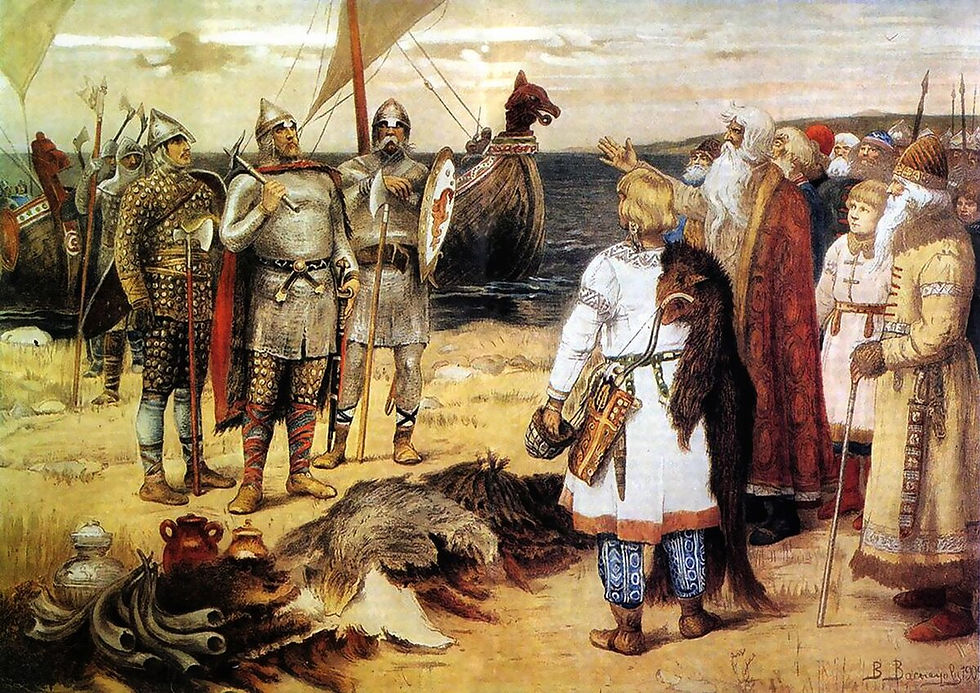
The nations of Russia, Ukraine, and Belarus can actually attribute their national heritage to Scandinavian vikings. This blog post will explore the history of the kingdom known as Kievan Rus and explain its incredibly important legacy, such as how it is influencing the current Russo-Ukrainian War.
The story of Kievan Rus begins in the 750s. Viking settlers moved eastwards from Scandinavia and established a trading outpost south of Lake Ladoga in present-day Russia. For decades, surrounding tribes of Slavic and Finnic people paid tribute to the Vikings. In between 860 and 862, these tribespeople decided to stop paying tribute, and they pushed the Vikings from their land. This resulted in a power vacuum in the region, centered around the valuable trading settlement of Novgorod. To restore order, the tribes decided to let a Norseman named Rurik rule over Novgorod. Rurik's brothers received adjacent territories.
Rurik was a member of a tribe known as Rus, which hailed from eastern Sweden. When his brothers died, he consolidated their territories into his own. After Rurik's death, a relative named Oleg the Wise succeeded his rule. Oleg took over the city of Kiev (now known as Kyiv) and became the first official Prince of Kiev, beginning the dynasty of Kievan Rus. Oleg solidified the power of Kievan Rus by mounting an assault against Constantinople, capital of the Byzantine Empire, in 907. According to legend, Oleg and his soldiers advanced on Constantinople's massive walls in longboats drawn by horses, strangely enough. Below is a medieval depiction of the event. Achieving victory in battle, Oleg secured a favorable trade agreement with the Byzantines, allowing Kievan Rus to thrive and grow.

Over the next century, the territory of Kievan Rus continuously expanded, encompassing land from Finland all the way down to the Balkans. In 980, Grand Prince Vladimir the Great came to power. At the time, Kievan Rus was a majority pagan kingdom, and Christians faced strong persecution. However, Vladimir sought the hand of a Byzantine princess named Anna. In order to marry her, the Byzantine emperor required Vladimir to convert himself and the whole population of Kievan Rus to Orthodox Christianity. Even today, the primary religion of Russia, Ukraine, and Belarus being Orthodox Christianity can be attributed to this single marriage in the 10th century.
The decline of Kievan Rus began in the 11th century, caused by a diminution in Kievan trade routes, and the simultaneous decline of the Byzantines, who were Kiev's most important trade partners. The kingdom slowly dissolved into small regional powers, and the fall of Kievan Rus occurred in the 13th century due to Mongol invasions.
Kievan Rus has left an important legacy that has influenced Eastern European politics for centuries now. In the 14th century, the Mongolian empire known as the Golden Horde appointed a man named Ivan I to the position of Grand Prince of Moscow. The title of Grand Prince was formerly used to denote a ruler of Kievan Rus. Ivan and his descendants used this position to justify their expansion into the lands that had once belonged to Kievan Rus. This type of expansion is quite similar to the current situation in Ukraine, with Moscow justifying Russian expansionism into lands that had once belonged to a nation they can claim to descend from.


Comments